Detection System

OVERVIEW

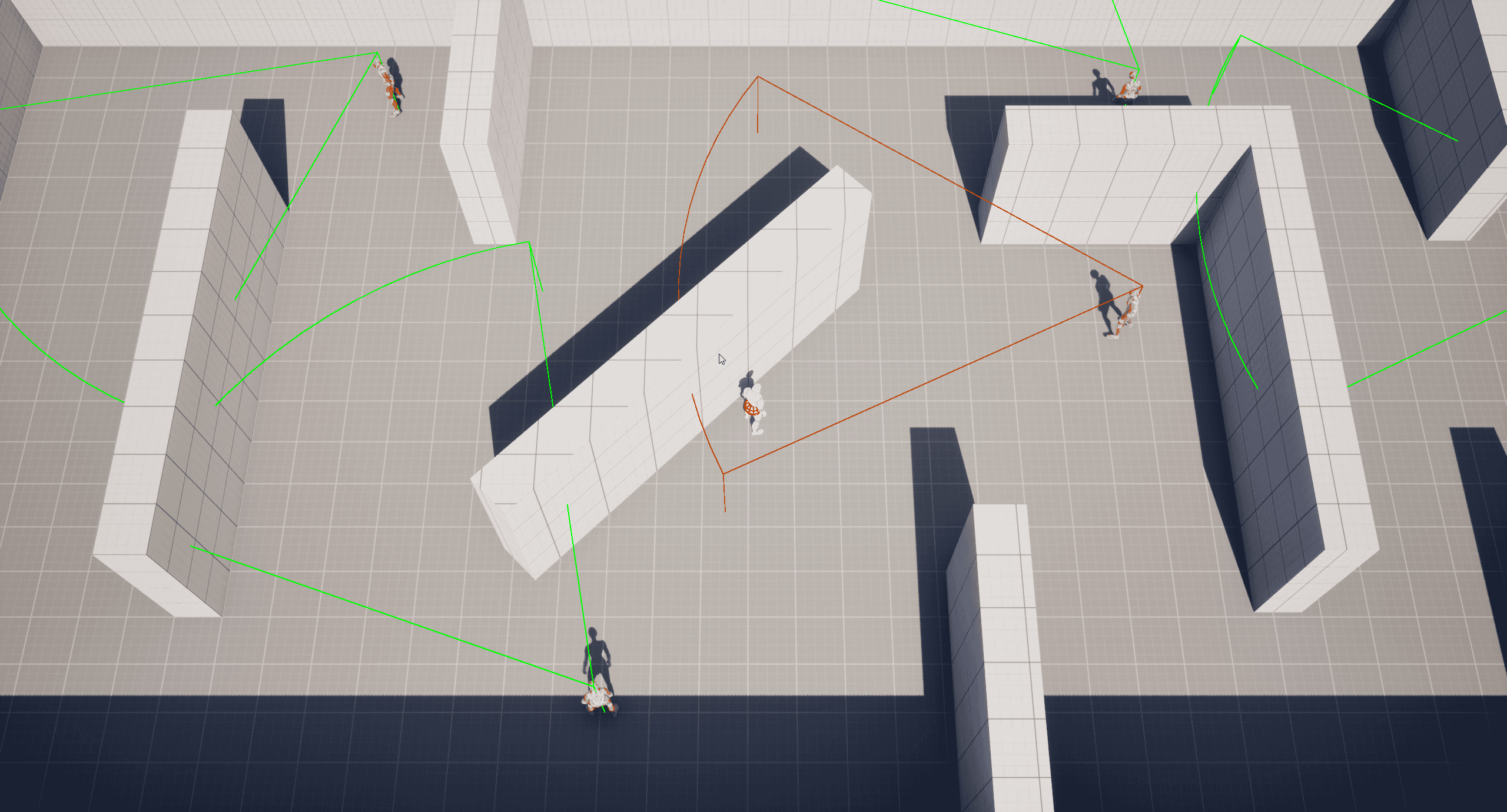
A speed-driven AI detection system for stealth and awareness gameplay, implemented in both Unity and Unreal Engine. Originally developed for production game projects, the system couples movement speed to detection rate through designer-authored curves, supporting multiple simultaneous detection targets with fully tunable detection behaviour and a playable web demo.

YEAR

2026

ROLE

PROGRAMMER

DESIGNER

SERVICES

GAMEPLAY PROGRAMMING

AI SYSTEMS

SYSTEM DESIGN

About the project

The system is built on a simple premise: how fast you move determines how fast you're seen. Every detectable agent reports a normalized speed that observers evaluate against detection curves, so a sprinting target fills an enemy's suspicion meter far faster than one creeping along the edge of its vision cone. Separate curves govern in-sight and out-of-sight detection, and a distance multiplier makes proximity matter, giving designers complete control over detection feel without touching code.

Each agent also carries a detection multiplier, a hook for gameplay events: firing a gun, breaking glass, or knocking over an object can spike an agent's visibility independent of movement, letting noisy actions carry real consequences.

I designed and implemented the system across both engines, including the perception layer (field-of-view, occlusion, and height checks), the suspicion accumulation model, and, in Unity, a jobified sensor manager that batches every observer's spatial queries into a single non-blocking job for scalable performance. The system supports multiple simultaneous detection targets, with a clear optimization path for collapsing to a single-target mode in single-player contexts.

Try it the playable web demo, or dig into the source on GitHub: Unity implementation · Unreal implementation
Smooth Scroll
This will hide itself!

Detection System

OVERVIEW

A speed-driven AI detection system for stealth and awareness gameplay, implemented in both Unity and Unreal Engine. Originally developed for production game projects, the system couples movement speed to detection rate through designer-authored curves, supporting multiple simultaneous detection targets with fully tunable detection behaviour and a playable web demo.

YEAR

2026

ROLE

PROGRAMMER

DESIGNER

SERVICES

GAMEPLAY PROGRAMMING

AI SYSTEMS

SYSTEM DESIGN

About the project

The system is built on a simple premise: how fast you move determines how fast you're seen. Every detectable agent reports a normalized speed that observers evaluate against detection curves, so a sprinting target fills an enemy's suspicion meter far faster than one creeping along the edge of its vision cone. Separate curves govern in-sight and out-of-sight detection, and a distance multiplier makes proximity matter, giving designers complete control over detection feel without touching code.

Each agent also carries a detection multiplier, a hook for gameplay events: firing a gun, breaking glass, or knocking over an object can spike an agent's visibility independent of movement, letting noisy actions carry real consequences.

I designed and implemented the system across both engines, including the perception layer (field-of-view, occlusion, and height checks), the suspicion accumulation model, and, in Unity, a jobified sensor manager that batches every observer's spatial queries into a single non-blocking job for scalable performance. The system supports multiple simultaneous detection targets, with a clear optimization path for collapsing to a single-target mode in single-player contexts.

Try it the playable web demo, or dig into the source on GitHub: Unity implementation · Unreal implementation

Smooth Scroll
This will hide itself!